Bubbles in the Bloodstream: Decompression Sickness in Sea Turtles
For many years, scientists believed that sea turtles were naturally protected against decompression sickness. Like other diving animals, they were thought to possess physiological adaptations that completely prevented the formation of harmful gas bubbles during dives.
Research led by the Fundación Oceanogràfic has fundamentally changed that understanding. Scientists demonstrated for the first time that sea turtles accidentally caught in fishing nets can develop decompression sickness, also known as decompression disease, a condition similar to that experienced by human divers.
This discovery has transformed both marine veterinary medicine and sea turtle conservation worldwide.
What is decompression sickness?
Decompression sickness occurs when nitrogen dissolved in the blood and tissues forms gas bubbles after changes in pressure.
A simple way to understand this process is to imagine opening a bottle of sparkling water. While the bottle is sealed, the gas remains dissolved under pressure. Once opened, bubbles rapidly appear.
A similar process can occur inside the body. During a dive, increased pressure allows more nitrogen to dissolve into body tissues. If protective mechanisms fail, gas bubbles may develop within blood vessels and organs, causing gas embolism and potentially life-threatening injuries.
The discovery that changed sea turtle conservation
Until recently, decompression sickness was considered a problem affecting only human divers.
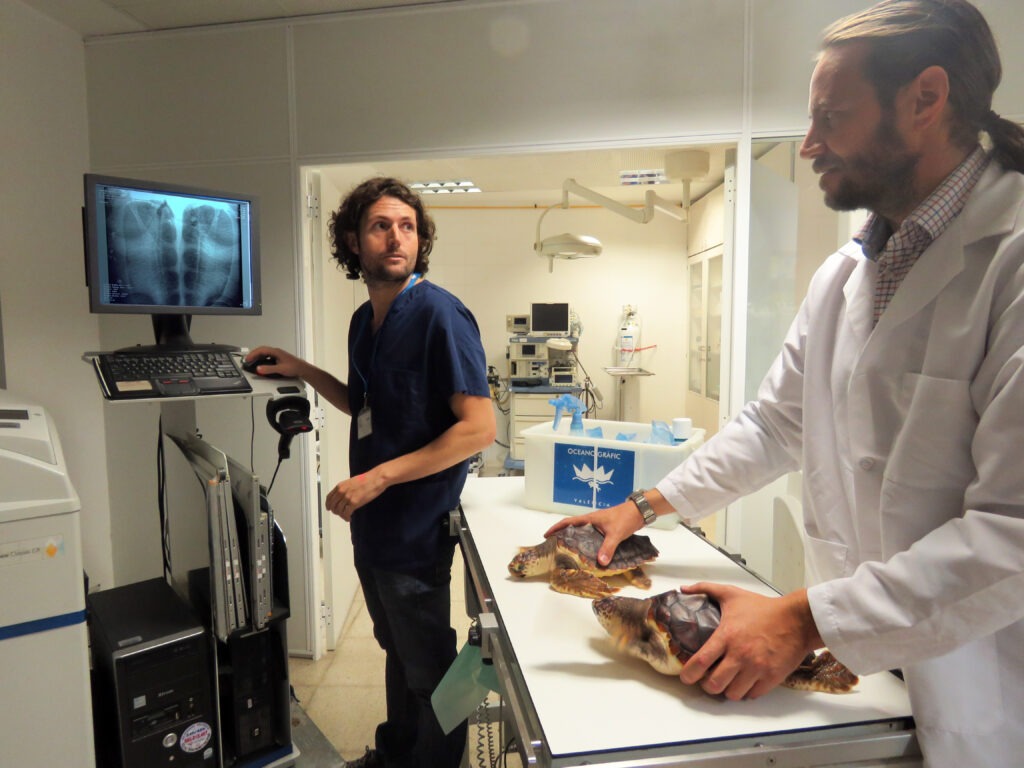
In 2014, veterinarians from the Oceanogràfic Foundation observed that some loggerhead (Caretta caretta) rescued after accidental capture in fishing nets died several days later despite appearing healthy when released.
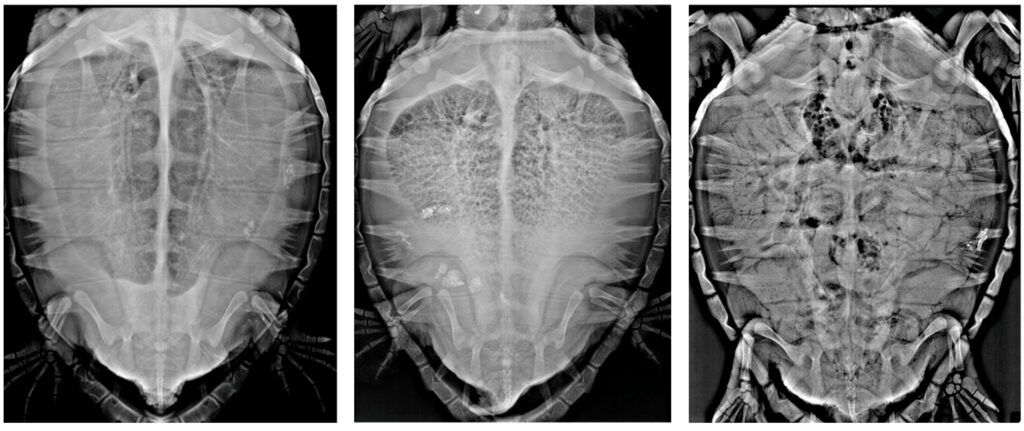
Diagnostic imaging revealed extensive gas embolism, and affected turtles recovered after treatment inside a hyperbaric chamber.
This groundbreaking discovery opened an entirely new field of research and changed how scientists evaluate fisheries-related mortality in sea turtles.
How does decompression sickness affect sea turtles?
Sea turtles possess remarkable physiological adaptations that normally protect them while diving.
During natural dives, a specialised sphincter located in the pulmonary artery restricts blood flow to the lungs. This greatly limits nitrogen uptake into the bloodstream and prevents gas bubble formation.
However, when turtles become trapped in fishing gear, stress hormones such as adrenaline relax this sphincter. Blood continues flowing through the lungs during the dive, allowing excess nitrogen to dissolve into the circulation.
As pressure changes, nitrogen can form bubbles within blood vessels and tissues, leading to gas embolism and decompression sickness.
Caption
Comparison of radiographs showing a healthy sea turtle (right), a drowned turtle (centre) and a turtle with severe gas embolism caused by decompression sickness (left). These diagnostic images provided key evidence demonstrating that sea turtles can develop decompression sickness following accidental capture in fishing gear.
More than half of accidentally captured sea turtles may develop gas embolism
Research published in Conservation Physiology showed that 54% of accidentally captured loggerhead sea turtles developed gas embolism.
The severity of the condition increases with:
- capture depth
- body size
- fishing gear type
- time spent underwater
These findings indicate that many turtles released immediately after capture may die days later if they do not receive appropriate treatment.
Hyperbaric treatment at Oceanogràfic Valencia
Every year, more than one hundred sea turtles arrive at the Oceanogràfic Foundation’s rehabilitation centre after accidental capture.
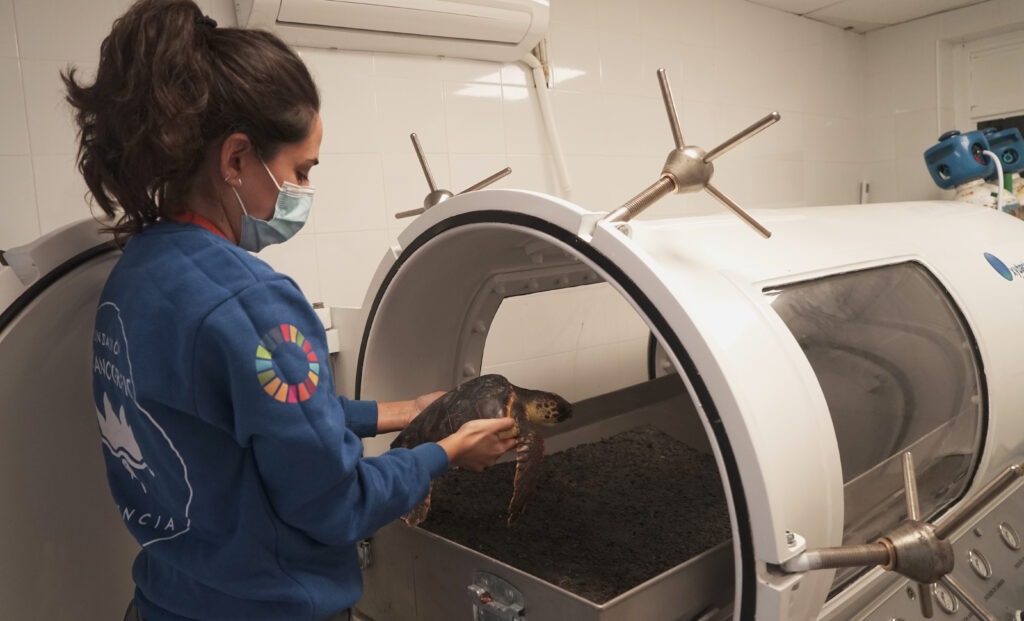
Many require hyperbaric oxygen therapy, the same treatment used for human divers suffering from decompression sickness.
Inside a hyperbaric chamber, pressure is carefully controlled to reduce gas bubbles and allow nitrogen to leave the body safely.
Thanks to collaboration with local fishermen, increasing numbers of affected turtles are transported directly to Oceanogràfic instead of being immediately released, significantly improving survival rates.
A discovery with international impact
The discovery made by Oceanogràfic researchers has reshaped scientific understanding of diving physiology in reptiles.
The findings have influenced conservation strategies worldwide and continue to improve veterinary protocols for rescued sea turtles.
Understanding how stress alters natural diving adaptations also helps scientists estimate the real impact of fisheries on threatened marine turtle populations.
What about marine mammals?
Oceanogràfic researchers have also investigated decompression sickness in marine mammals.
Studies involving Steller sea lions suggest that marine mammals possess sophisticated physiological mechanisms to regulate gas exchange during dives. However, intense stress or human disturbances such as underwater noise may interfere with these protective adaptations, increasing the risk of gas bubble formation.
These studies continue to improve our understanding of diving physiology across different marine species.
Protecting sea turtles also means preventing decompression sickness
The discovery that sea turtles can suffer decompression sickness represents one of the Oceanogràfic Foundation’s most significant scientific achievements.
Today, this research contributes directly to wildlife conservation by improving rescue protocols, informing fisheries management and increasing survival rates for accidentally captured sea turtles.
Every rescued turtle provides valuable information that helps protect future generations of these remarkable marine reptiles.
Yes. Research led by the Oceanogràfic Foundation demonstrated that sea turtles can develop decompression sickness after accidental capture in fishing gear.
Gas embolism occurs when gas bubbles form inside blood vessels or tissues, blocking normal blood circulation and damaging organs.
Sea turtles diagnosed with decompression sickness receive hyperbaric oxygen therapy, which safely removes gas bubbles from the body before they are released back into the wild.
Stress caused by entanglement alters the turtle’s natural diving physiology, allowing excess nitrogen to enter the bloodstream and increasing the risk of gas embolism.
Until 2014, scientists believed sea turtles were naturally protected against decompression sickness. Oceanogràfic researchers demonstrated that this assumption was incorrect, changing veterinary medicine and sea turtle conservation worldwide.
Scientific references
- García-Párraga D. et al. (2018). Deciphering function of the pulmonary arterial sphincters in loggerhead sea turtles (Caretta caretta). Journal of Experimental Biology. DOI: 10.1242/jeb.179820
- García-Párraga D. et al. (2023). New insights into risk variables associated with gas embolism in loggerhead sea turtles (Caretta caretta) caught in trawls and gillnets. Conservation Physiology. DOI: 10.1093/conphys/coad048